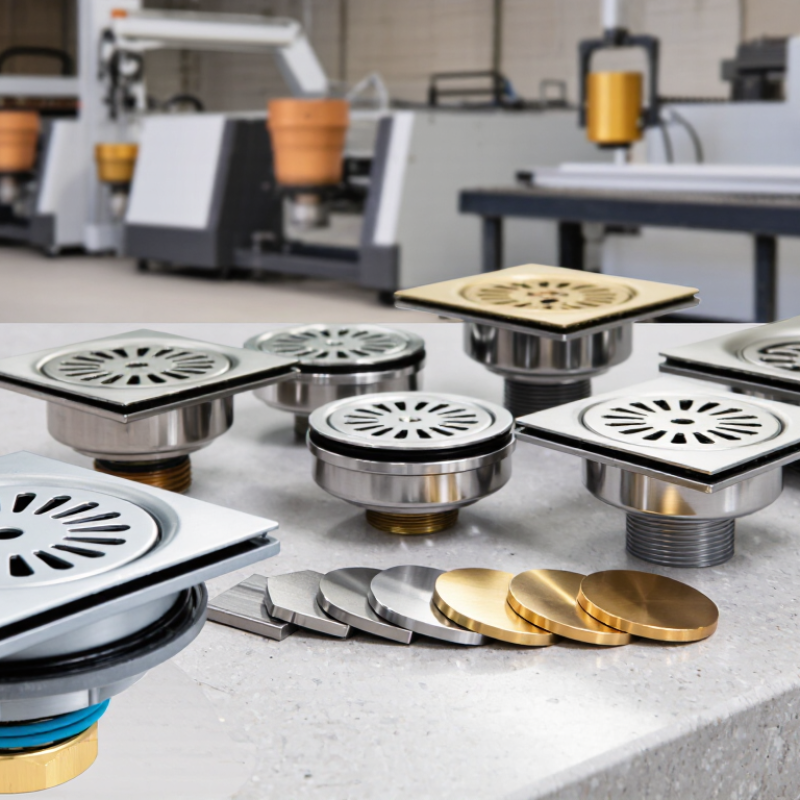
China Top Drain Trim Set Manufacturers for Global Buyers
China has become a major sourcing base for bathroom hardware, including the Drain Trim Set category. Its manufacturing network combines stainless steel processing, brass casting, laser cutting, and surface finishing. The WHO and UNICEF Joint Monitoring Programme reported that 3.5 billion people lacked safely managed sanitation in 2022. This figure reflects long-term infrastructure demand, although it does not measure Drain Trim Set sales directly. The global plumbing fixtures market is also expected to expand, according to Grand View Research’s industry analysis. Market growth alone, however, does not guarantee reliable suppliers.
For global buyers, manufacturer selection requires more than attractive product images. Check 304 or 316 stainless steel grades, drain outlet compatibility, load resistance, sealing performance, and surface treatment consistency. A polished catalog can still hide weak welds or uneven PVD coating. Ask for material certificates, dimensional drawings, production samples, and inspection records. ISO 9001 certification can support process confidence, but it should not replace independent quality checks. The category is not perfectly standardized.
Practical sourcing experience matters. Confirm grate size, tile-insert depth, odor-control design, packaging protection, and replacement-part availability before placing an order. China’s leading manufacturers often support OEM branding, custom molds, and mixed-container shipments. Yet customization may increase tooling costs and delivery time. Buyers should compare total landed cost, not only factory price. This includes freight, testing, import duties, and warranty handling. Reliable communication is essential. So is documentation. A dependable Drain Trim Set manufacturer should explain limitations clearly, rather than promise every specification without evidence.
Drain Trim Sets: Definition, Components, and Main Applications
China Top Drain Trim Set Manufacturers for Global Buyers
Drain Trim Sets: Definition, Components, and Main Applications
A drain trim set is the visible and functional assembly installed around a floor or shower drain. It connects the drain opening with the surrounding waterproof surface. In practical projects, buyers usually inspect the grate, frame, clamping ring, sealing gasket, and adjustable support parts. Some sets also include a removable hair catcher or a tile-insert tray. Small components matter.
The grate controls water entry and affects the finished appearance. The frame supports the edge of the opening and helps maintain alignment. A clamping ring secures the waterproof membrane, while gaskets reduce leakage risks around joints. Stainless steel is common because it resists corrosion and tolerates frequent cleaning. However, material grade, surface treatment, and installation quality can vary. A polished surface may still show scratches after poor handling.
Drain trim sets serve bathrooms, wet rooms, commercial kitchens, balconies, laundry areas, and accessible shower spaces. Tile-insert models create a nearly continuous floor pattern. Slotted grates usually provide faster visual inspection and easier maintenance. Experienced buyers check outlet size, grate load rating, sealing compatibility, and height adjustment before ordering. Site measurements can still be missed, especially where floor slopes are uneven. Clear drawings and sample testing help confirm fit before volume production. Certified production controls and documented inspection records also improve purchasing reliability.
China’s Drain Trim Set Manufacturing Landscape
China’s drain trim set manufacturing landscape is shaped by dense supplier networks, metalworking capacity, and export experience. Factories commonly combine stamping, CNC machining, polishing, plating, and final assembly. This supports flexible production for shower drains, overflow covers, grates, and matching accessories.
Mordor Intelligence estimates the global bathroom fixtures market at about USD 88 billion in 2024, with steady growth through 2029. That demand encourages Chinese manufacturers to offer stainless steel, brass, and engineered polymer options. UN Comtrade data also places China among the leading exporters in HS 7324 sanitary ware categories. However, HS codes rarely isolate drain trim sets. This limits direct market comparisons and requires careful buyer research. The National Bureau of Statistics reported China’s 2024 manufacturing PMI at 49.8, reflecting uneven factory conditions. Some suppliers invest in automated inspection, while others still rely heavily on manual checking. Quality can vary.
Tips: Ask for salt-spray results, coating thickness records, dimensional tolerances, and drain compatibility drawings. Request production samples before approving bulk orders. Check whether the stated material applies to every visible component, not only the grate. A polished surface may look excellent under showroom lights but reveal pinholes later. Packaging also deserves attention; loose metal parts can scratch each other during ocean transport. Clear inspection criteria reduce disputes, although they cannot replace an independent pre-shipment check.
Key Criteria for Evaluating Chinese Drain Trim Set Manufacturers
When evaluating Chinese drain trim set manufacturers, begin with evidence rather than catalog photos. Request factory registration details, production addresses, and a live video tour of the stamping and finishing areas. Experienced suppliers should explain material grades, surface treatments, tolerances, and drain compatibility without vague claims. Ask for inspection records. Check whether stainless steel, brass, or coated components match the declared specification. An independent material report is useful when appearance alone cannot confirm composition. Small details matter.
Sample evaluation should include threads, gasket seating, screw alignment, and water flow. Install each sample with the intended pipe size and inspect it after repeated wetting and drying. Look for sharp edges, uneven plating, loose fasteners, or standing water around the trim. These defects may not appear in a showroom sample. Ask how the factory controls incoming materials, batch inspection, final packing, and corrective actions. Photographs of marked cartons and inspection labels can reveal whether procedures are actually used. Do not judge only by price.
Reliable export partners provide clear drawings, test standards, carton data, lead times, and replacement procedures. They should confirm tolerances in writing and identify who approves changes. Communication quality is a practical quality signal. Replies that avoid measurements deserve caution. Review production capacity against your order volume, especially before seasonal demand rises. A factory may promise fast delivery, yet subcontract finishing without disclosure. That gap deserves a direct question. Even careful buyers can overvalue a flawless sample; ongoing audits and random checks remain necessary.
Production Standards, Quality Control, and Customization Options
China Top Drain Trim Set Manufacturers for Global Buyers
Reliable drain trim set manufacturing begins with controlled production standards. Experienced factories usually define material grades, wall thickness, surface finish, and dimensional tolerances before cutting begins. Stainless steel, brass, and coated alloys require different inspection methods. Clear process sheets help workers repeat each step, even during large orders. Small details matter. A 0.2-millimeter size variation can affect installation on site. Incoming materials should be checked against purchase specifications, not accepted by appearance alone.
Quality control should continue through forming, polishing, plating, assembly, and packaging. Inspectors may use calipers, coating gauges, thread gauges, and visual light checks. Water-flow testing can reveal blocked openings or poor drainage design. Sampling plans reduce inspection costs, but critical dimensions deserve tighter control. No factory process is flawless. A scratched surface or loose fitting can still escape during busy production periods. Honest suppliers record defects, investigate causes, and adjust work instructions instead of hiding rework.
Customization gives global buyers more practical flexibility. Manufacturers can adapt grate patterns, outlet sizes, finishes, logos, carton labels, and installation accessories. Technical drawings should show tolerances, materials, and testing requirements. Pre-production samples prevent expensive misunderstandings. Buyers should also confirm packaging strength for humid warehouses and long-distance shipping. In practice, communication is sometimes the weakest link. A revised drawing may reach production late. Written approvals, inspection photos, and batch records make accountability clearer.
| Evaluation Dimension | Common Production Reference | Quality-Control Checkpoints | Customization Options for Global Buyers |
|---|---|---|---|
| Product Scope |
| Check component compatibility, assembly completeness, thread engagement, gasket placement, and drainage performance. | Single-piece or complete-set supply; optional overflow, push-button, pop-up, or grid-strainer configurations. |
| Common Drain Sizes |
| Verify nominal size, thread profile, installation height, nut dimensions, and compatibility with the destination plumbing system. | Custom outlet diameter, tailpiece length, thread type, overflow slot position, and installation depth. |
| Primary Materials |
| Material certificates, alloy identification, dimensional inspection, surface inspection, and hardness or composition verification when specified. | 304 or 316 stainless steel; brass bodies; alternative seal compounds; material thickness and weight targets. |
| Surface Finishes |
| Check color consistency, gloss or texture uniformity, adhesion, coverage, visible defects, and resistance to handling marks. | Brushed, satin, polished, chrome, PVD-style decorative finishes, or customer-approved color samples. |
| Applicable Product Standards |
| Review the latest applicable edition, required dimensions, functional tests, marking rules, and test reports for the target market. | Testing and documentation can be aligned with European, North American, Australian, or other destination-market requirements. |
| Stainless Steel Treatment | Passivation may be specified for stainless-steel components to improve resistance to free iron contamination and corrosion initiation. | Process records, surface cleanliness, visual inspection, and passivation verification according to the agreed specification. | Pickling and passivation, electropolishing, brushed surface direction, and controlled surface roughness requirements. |
| Plating and Coating Control | Decorative nickel-chromium plating and other finishes should be controlled according to the agreed coating system and target market. | Coating thickness, adhesion, appearance, porosity, corrosion resistance, and batch-to-batch color consistency. | Specify coating stack, minimum thickness, gloss level, color tolerance, salt-spray test duration, and inspection method. |
| Corrosion Testing | Neutral salt-spray testing may be used as a comparative corrosion-resistance test for plated or coated surfaces. | Test method, exposure duration, rating criteria, and acceptance limits should be agreed before mass production. ASTM B117 and ISO 9227 describe test procedures, not universal acceptance levels. | Buyer-defined exposure time, corrosion rating, edge-treatment requirement, and sample approval process. |
| Leak and Drainage Testing | Finished assemblies should be checked for water tightness and unobstructed drainage after installation with the specified seals and fittings. | Leak test at the waste connection, seal inspection, pop-up or stopper operation, overflow function where included, and drainage-flow observation. | Custom test pressure or duration, water-flow requirement, stopper travel, actuation force, and overflow capacity criteria. |
| Dimensional Accuracy | Critical dimensions include outlet diameter, thread dimensions, body height, flange diameter, gasket thickness, and tailpiece length. | Use calibrated gauges, thread gauges, vernier calipers, height gauges, and approved inspection drawings. | Buyer drawings, 2D or 3D CAD files, tolerance tables, datum references, and first-article approval. |
| Seal and Gasket Performance | Sealing materials should be selected for contact with water, temperature range, compression, and chemical compatibility. | Check dimensions, compression, elasticity, surface defects, leakage after assembly, and compatibility with the drain body and basin. | EPDM, silicone, or other agreed compounds; custom profiles, colors, hardness, and gasket thickness. |
| Production Process Control |
| Use approved work instructions, process parameters, traceability records, in-process inspection, and final sampling plans. | Customer-approved control plans, special characteristics, inspection frequency, and process capability studies for critical dimensions. |
| Quality Management | ISO 9001 is a widely used quality-management framework for controlling documented processes, corrective actions, and continual improvement. | Confirm certificate validity, scope, issuing body, manufacturing site, document control, nonconformance handling, and corrective-action records. | Additional supplier audits, quality agreements, batch traceability, inspection reports, and third-party pre-shipment inspection. |
| Sampling and Inspection | ANSI/ASQ Z1.4 or an equivalent agreed sampling plan may be used for lot-based visual, dimensional, and functional inspection. | Define inspection level, AQL values, critical defects, major defects, minor defects, and rejection procedures before order confirmation. | 100% inspection for critical sealing or cosmetic features; reduced or tightened sampling for other characteristics. |
| Customization Capability | Customization commonly covers geometry, material, finish, logo-free packaging, assembly method, and installation accessories. | Approve drawings, samples, finish panels, materials, packaging artwork, and pre-production samples before mass production. | OEM drawings, private-label-neutral packaging, custom color, special overflow design, modified actuation mechanism, and accessory kits. |
| Packaging and Protection | Individual protection may include bags, sleeves, molded inserts, cartons, and moisture-resistant outer packaging. | Check scratch protection, component separation, carton compression, drop resistance, labeling accuracy, and quantity reconciliation. | Retail box, bulk carton, recyclable packaging, multilingual labels, barcode labels, installation instructions, and pallet specifications. |
| Documentation for Export Buyers | Typical documentation includes commercial invoice, packing list, product specification, inspection report, and material or test records when required. | Match documents to purchase-order requirements, shipment quantity, lot number, product revision, and destination-country rules. | Custom inspection templates, certificates of conformity, material declarations, test reports, installation guides, and multilingual documentation. |
| Pre-Production Approval | A controlled approval process normally includes technical drawing review, sample production, functional testing, and finish confirmation. | Record approved sample dimensions, materials, surface finish, packaging, and acceptance criteria before production release. | Golden sample, sealed reference sample, digital approval, third-party laboratory testing, and buyer witness inspection. |
| Lead-Time Planning | Production timing depends on tooling, material availability, plating or finishing capacity, sample approval, and order quantity. | Confirm sample date, production start, inspection date, estimated completion, and shipment readiness in a written schedule. | Separate schedules for standard items, modified items, new tooling, special finishes, and custom packaging. |

Export Readiness, Pricing Factors, and Supplier Selection
Export readiness starts with more than factory capacity. A reliable manufacturer should provide drawings, material details, finish samples, packing specifications, and accurate commercial documents. Ask whether the drain trim set suits your target market’s installation standards. Check thread sizes, flange dimensions, surface protection, and compatibility with local plumbing systems. Small mismatches can create costly site delays. I have found that sample approval is useful, but one sample cannot prove long-term consistency.
Pricing depends on stainless steel grade, brass content, machining time, coating method, order volume, packaging, and tooling. Freight, currency changes, and inspection fees also affect the final landed cost. A low quotation may exclude protective film or spare parts. Compare itemized offers instead of headline prices. Supplier selection should include production photos, quality records, pre-shipment inspection, and clear lead-time commitments. Video audits help, though they are not perfect. Factory visits remain valuable when order volumes justify them.
Tips: Request three samples from different batches. Test fit and finish before mass production. Confirm carton drop-test results and moisture protection. Keep written approval records. Avoid choosing only by price; stable communication often saves more than a small discount.