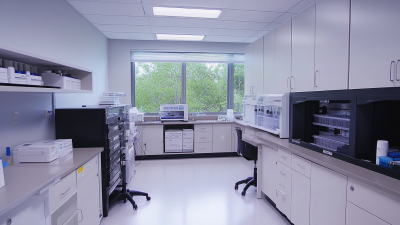




2026 Best Lab Tools for Global Buyers?
Choosing the best Lab Tools for global buyers in 2026 requires more than comparing prices and polished product images. A reliable laboratory depends on accurate measurements, stable performance, service access, and clear documentation. A pipette that feels smooth in a showroom may drift after months of daily use. A compact centrifuge may save bench space but struggle with vibration control. Small details matter.
Professor George M. Whitesides, a leading chemist and laboratory methods expert, once said, “The best way to learn about something is to do it.” That practical idea remains valuable when evaluating Lab Tools across different markets. Buyers should examine calibration records, material quality, electrical compatibility, software support, and replacement-part availability. They should also ask whether local technicians can repair the instrument quickly. A low purchase price can become expensive when shipping takes six weeks.
This guide explores the Lab Tools that deserve attention in 2026, from precision pipettes and analytical balances to centrifuges, microscopes, and safety equipment. It considers research laboratories, educational institutions, clinical settings, and industrial facilities. Standards and purchasing conditions vary by country. No single product fits every laboratory. That is the difficult part. Some recommendations may change when real users report noise, maintenance delays, or confusing interfaces. Those weaknesses deserve attention, not concealment. Global buyers need dependable evidence, not exaggerated claims. Practical testing, transparent specifications, and responsible sourcing provide a stronger foundation for confident decisions.

Global Lab Tools Market: USD 55.1B in 2023 and 7.2% CAGR to 2030
2026 Best Lab Tools for Global Buyers?
Global Lab Tools Market: USD 55.1B in 2023 and 7.2% CAGR to 2030
The global laboratory tools market reached USD 55.1 billion in 2023. It is projected to grow at a 7.2% CAGR through 2030. This growth reflects stronger demand for accurate testing, digital records, and faster research workflows. Global buyers should evaluate tools by application, not appearance. A compact centrifuge, for example, must deliver stable speed, low vibration, and simple maintenance. Microscopes need clear imaging, durable illumination, and compatible accessories. Daily usability matters more than a polished specification sheet.
Procurement teams should verify calibration support, training resources, spare-part access, and regional service coverage. These details can decide whether equipment supports a laboratory or interrupts it. Energy use also deserves attention, especially in facilities running incubators and freezers continuously. In my experience, buyers often compare purchase prices too closely and underestimate installation costs. That approach is understandable, but incomplete. No market forecast is flawless. Currency shifts, supply delays, and changing standards can affect the final decision. A practical evaluation should include sample testing, total ownership cost, and feedback from technicians who will use the tools daily. Small operational details often reveal the real value.
2026 Best Lab Tools for Global Buyers? - Global Lab Tools Market: USD 55.1B in 2023 and 7.2% CAGR to 2030
Buyer-oriented market outlook and selection guide by laboratory tool category
| Tool Category | Primary Laboratory Use | Key 2026 Buying Criteria | Common Performance Measures | Typical Users | Global Purchasing Notes |
|---|---|---|---|---|---|
| Analytical Balances | High-precision mass measurement for sample preparation, formulation, and quality control. | Readability, repeatability, calibration workflow, draft-shield design, environmental stability, and data connectivity. | Readability from milligrams to sub-milligram levels; repeatability; linearity; stabilization time. | Pharmaceutical, chemical, food, academic, and industrial laboratories. | Confirm local calibration, electrical compatibility, service coverage, and metrology documentation. |
| Centrifuges | Separates suspended particles, cells, precipitates, and biological components by centrifugal force. | Maximum relative centrifugal force, rotor capacity, temperature control, imbalance protection, and containment. | Speed in revolutions per minute, relative centrifugal force, capacity, acceleration/deceleration profile, temperature range. | Life-science, clinical, environmental, food, and research laboratories. | Check rotor availability, tube compatibility, biosafety requirements, and replacement-part logistics. |
| Microscopes | Visualizes cells, tissues, particles, materials, and surface structures. | Optical resolution, illumination, contrast techniques, camera integration, ergonomic design, and software compatibility. | Magnification, numerical aperture, resolution, field of view, illumination intensity, image quality. | Clinical, academic, pathology, materials, semiconductor, and quality laboratories. | Evaluate objective standards, imaging-file formats, training needs, and regional technical support. |
| Spectrophotometers | Measures light absorption or transmission to quantify chemical and biological samples. | Wavelength range, photometric accuracy, stray-light performance, cuvette compatibility, and software traceability. | Wavelength accuracy, photometric accuracy, spectral bandwidth, detection limit, and measurement repeatability. | Pharmaceutical, environmental, food, clinical, biotechnology, and teaching laboratories. | Request calibration certificates, validation support, compatible consumables, and export documentation. |
| Chromatography Systems | Separates, identifies, and quantifies components in complex mixtures. | Pressure range, detector selection, injection precision, solvent management, automation, and data integrity. | Resolution, retention-time repeatability, sensitivity, flow-rate accuracy, pressure stability. | Pharmaceutical, petrochemical, food, forensic, environmental, and research laboratories. | Budget for columns, gases or solvents, preventive maintenance, compliance software, and operator training. |
| PCR and Thermal Cyclers | Amplifies targeted nucleic-acid sequences for research, diagnostics, and quality testing. | Temperature uniformity, ramp rate, sample throughput, optical detection, contamination control, and software. | Temperature accuracy, well-to-well uniformity, ramp rate, block capacity, fluorescence channels. | Molecular biology, clinical research, food safety, agriculture, and biotechnology laboratories. | Verify consumable format, regional regulatory requirements, data-export options, and contamination-prevention design. |
| Incubators and Ovens | Provides controlled temperature, humidity, or atmospheric conditions for growth, drying, and testing. | Temperature uniformity, recovery time, chamber volume, humidity or CO2 control, alarms, and cleaning access. | Temperature range, stability, uniformity, recovery time, humidity accuracy, and usable capacity. | Microbiology, cell culture, food, pharmaceutical, materials, and testing laboratories. | Compare energy consumption, chamber materials, validation documentation, shipping protection, and local installation service. |
| Water Purification Systems | Produces laboratory water for reagents, instruments, rinsing, and analytical workflows. | Required water grade, feed-water quality, purification stages, monitoring, storage, and consumable life. | Resistivity, total organic carbon, microbial control, particle level, flow rate, and system recovery. | Clinical, pharmaceutical, analytical, biotechnology, electronics, and academic laboratories. | Assess feed-water chemistry, replacement-filter availability, water standards, installation plumbing, and service intervals. |
Global Lab Tools Market Outlook
| Year | Estimated Market Value | Calculation Basis | Buyer Implication |
|---|---|---|---|
| 2023 | USD 55.1 billion | Reference market size stated in the supplied title. | A large and diversified market supports broad sourcing options across laboratory equipment categories. |
| 2026 | Approximately USD 67.9 billion | Calculated as USD 55.1 billion × 1.0723. | Prioritize interoperable systems, remote service capability, and reliable consumables supply. |
| 2030 | Approximately USD 89.0 billion | Calculated as USD 55.1 billion × 1.0727, using the stated 7.2% CAGR. | Lifecycle cost, software compatibility, cybersecurity, sustainability, and upgradeability become increasingly important. |
Note: The 2026 and 2030 market values are mathematical projections based solely on the supplied 2023 market size and 7.2% compound annual growth rate; they are not company or brand sales figures.
Core Lab Tool Categories: Accuracy, Throughput, and ISO/IEC 17025 Criteria
2026 Best Lab Tools for Global Buyers?
Selecting laboratory tools requires more than comparing prices. Accuracy determines whether a result can support a technical decision. Throughput shows how many samples a team can process without creating delays. These priorities can conflict. A faster instrument may produce more variation when operators rush. A highly precise system may slow routine testing. Buyers should examine repeatability, measurement range, resolution, and performance under daily working conditions.
ISO/IEC 17025 criteria add practical discipline to the evaluation. Check calibration certificates, measurement traceability, uncertainty statements, and maintenance records. Confirm that staff can operate the equipment competently. Environmental controls also matter. Temperature, humidity, vibration, and electrical stability can influence results. During supplier discussions, request documented test methods and service response procedures. Claims without evidence are weak. I have seen purchasing teams focus on specifications, then overlook software records or staff training. That mistake is expensive.
Tips: Compare real sample workloads, not ideal capacity. Ask for a demonstration using similar materials. Review calibration intervals and spare-part access before approval. Keep a written risk assessment for every critical tool. Leave room for doubt. A checklist may miss an inconvenient detail. Recheck the evidence with laboratory users, quality personnel, and technical managers before purchase.
2026 Best Lab Tools for Global Buyers
Core lab tool categories evaluated by accuracy, throughput, traceability, data integrity, and ISO/IEC 17025 readiness.
This normalized 0–100 procurement index is a transparent decision framework rather than a market-share ranking. Accuracy and traceability reflect measurement reliability, throughput reflects processing capacity, and ISO/IEC 17025 readiness emphasizes calibration records, validated methods, competent personnel, equipment control, and documented evidence.
Selecting 2026 Instruments by Detection Limits, Tolerance, and Capacity
For global laboratory buyers, the best 2026 instrument is not always the most advanced. Selection should begin with detection limits, tolerance, and working capacity. In daily testing, I compare the stated detection limit with results from low-level reference samples. A specification alone can mislead. If a method detects 0.1 units but varies widely near that level, its practical value falls.
Tolerance deserves equal attention. Temperature drift, volume error, pressure variation, and calibration stability can change a credible result. Ask for traceable calibration records and uncertainty data, not attractive claims.
I also examine capacity: sample volume, batch size, chamber space, data storage, and future workload. A small device may fit one bench, yet create delays during seasonal demand. Measure the queue.
Global procurement adds practical tests. Confirm voltage compatibility, environmental operating ranges, service response, spare-part access, and training materials. Documentation should explain maintenance intervals in clear technical language. Independent proficiency testing or published validation evidence can strengthen confidence across different laboratories.
I would run a site acceptance test using representative samples before full deployment. Record repeatability, recovery, carryover, and downtime. Do not ignore awkward details. Predicted capacity often assumes perfect operators and uninterrupted supplies. Real laboratories rarely work that neatly. A careful buyer should leave margin for mistakes, repairs, and changing methods.
Global Compliance Essentials: ISO 15189, IEC 61010-1, CE, and FDA Rules
2026 Best Lab Tools for Global Buyers?
Global buyers need more than attractive specifications. A laboratory tool must fit its intended use, risk level, and destination market. ISO 15189 focuses on laboratory competence, including validation, traceability, staff skills, and reliable records. It does not automatically certify every instrument. IEC 61010-1 addresses electrical safety, insulation, temperature limits, and protection from foreseeable hazards. These details matter when equipment operates beside water, reagents, or high voltage.
Tips: Request the declaration of conformity, test reports, user instructions, and maintenance records before purchasing. Check whether CE marking applies to the complete device or only selected components. For the United States, review FDA classification, registration, listing, labeling, and possible premarket requirements. Do not treat a supplier’s compliance statement as final evidence. Ask who issued each document and whether its scope matches the exact model.
Procurement teams should also compare calibration intervals, software controls, cybersecurity risks, and spare-part access. A tool may meet IEC 61010-1 yet still require laboratory validation under ISO 15189. CE requirements can involve several directives, not just electrical safety. FDA expectations may change with the device’s intended use and claims. These areas are often misunderstood. One overlooked issue is local service capability; delayed calibration can weaken otherwise strong quality records. Compliance checks should be documented before shipment, installation, and routine use.
Total Cost Analysis: Five-Year TCO, 95% Uptime, Service, and Supply Risks
2026 Best Lab Tools for Global Buyers?
A credible five-year TCO model includes purchase price, installation, energy, calibration, consumables, training, service, and disposal. It also prices downtime. At 95% uptime, one instrument may lose 18.25 days annually, or over 91 days across five years. That figure is uncomfortable. It is also easy to overlook.
The Uptime Institute’s 2024 Global Data Center Survey reported that 54% of recent outages cost below $100,000, while 16% exceeded $1 million. Laboratory downtime rarely reaches those extremes, but the valuation method remains useful. Calculate delayed batches, technician hours, replacement rentals, and missed delivery windows. Service contracts should specify response times, spare-part availability, preventive maintenance, and calibration traceability. A low annual fee can hide costly exclusions.
Supply risk deserves equal weight. McKinsey Global Institute’s “Risk, Resilience, and Rebalancing in Global Value Chains” found that disruptions lasting one month or longer may occur every 3.7 years. Buyers should therefore examine component origin, regional inventory, substitute parts, and customs lead times. A two-year warranty is not the same as operational resilience. My own caution is simple: forecasts often assume perfect technician access and stable electricity. That is rarely realistic. Test the model with a delayed shipment, a failed sensor, and three weeks without local service.
Related Posts
-
Maximizing Laboratory Efficiency with Cutting Edge Lab Instruments for Enhanced Research Productivity
-

Understanding Best Lab Instruments Specifications and How to Choose the Right One
-

Understanding Global Standards for Best Laboratory Tools and Equipment and Their Impact on Your Procurement Decisions
-
Laboratory Instrumentation Showdown: Choosing the Right Tools for Your Research Needs
-
Essential Laboratory Tools for Accurate Scientific Experimentation Techniques
-
How to Choose the Right Lab Equipment for Your Scientific Needs